I wish I could tell you the name of the company, but I can only tell you what happened. Those of you in the St. Petersburg area will at least know to pay attention. Unfortunately, human nature being what it is, this problem may not be exclusive to St. Petersburg.
The St. Petersburg Power and Sailboat Show will take place December 4 - 7 of 2014. It's an annual event, one I have enjoyed. In 2012 I worked at the show on behalf of Boca Ciega Yacht Club. All the volunteers had some time off to visit the other booths. There was a rope vender across the path and west just a bit west of BCYC's booth in 2012, and the prices were too good to resist. I talked with another member who has the same boat as mine, and then went to the rope vender and bought 120' of 3/8" line, at what seemed like a very good price, to use as a spinnaker halyard. I told him what it was to be used for, and he told me he had "some" halyard line left. I want to be clear here; the vender presented himself as knowledgeable regarding lines for sailboats. He assured me that he had a small amount left, just enough, and that he would set it aside for me.
A friend installed this line as a spinnaker halyard for me. I don't have a spinnaker sail; I intended to use it to move heavy things, such as the air conditioner, on and off the boat. It didn't work very well, though. It was extremely hard to raise the air conditioner even a few inches so it could be swung over to the dock. Then I tried to use it to raise my storm sail over the roller furler, and it simply wouldn't do it. Friends took a look at it, and noted the same thing I did: the halyard seemed to run freely until there was any amount of appreciable weight on it. Then it simply wouldn't budge. However, when it had no load, it ran quite freely through all hardware including the sheave at the top of the mast.
Today someone figured out why the line was so difficult to use under load. This supposed halyard rope was not that at all. It was ... polypropelene! It was covered with woven threads, but it had a polypro core. It's cheap line that can't take much strain and that stretches until it breaks. Today's helper noted that as we pulled on the halyard (with someone sitting in a bosun's chair at the end of it to provide load), the line stretched significantly without raising the bosun's chair at all. I had thought it was just me, not as strong as I used to be after being laid up for a while, but three different strong people had not been able to raise it under load. We cut the end to examine the core.
It's really quite scary. In a storm I would have counted on that halyard to keep the storm sail up, and it might not have been up to the task, leaving me in a storm but with essentially no steering, no ability to either heave to or point the boat into the wind.
To me, selling such line to a sailor pretending that it would be suitable for a halyard borders on sociopathic behavior. I would not say that if I knew the name of the company, but I have tried and have not been able to trace it down. Since I can't provide the name of the company, all I can do is describe the danger presented by such sales behavior.
Stretch is not always bad. It's good to have a little stretch in one's dock lines, for instance. Polypropelene can also be useful, as it floats. But it isn't nearly as strong as other lines, and it's particularly susceptible to UV damage. Diameter for diameter, it's a weak rope. Between its weakness, its vulnerability to UV rays and its marked ability to stretch, it's a terrible choice for a halyard.
So all I can say is, "Buyers beware." Venders with Swiss cheese for consciences can spot a beginner from a mile away. You really can get some great deals at boat shows, but if you aren't 150% certain regarding what you're looking at, bring a more experienced friend along.
Showing posts with label running rigging. Show all posts
Showing posts with label running rigging. Show all posts
Tuesday, May 6, 2014

Tuesday, April 22, 2014
Wearing Gloves ...
or, Someone Really Could Die!
This happened in the marina I live in recently. A man was climbing up his very tall mast, with his wife on the halyard as a safety line.
I don't know what went wrong at the mast, but he slipped, and he needed that safety line to catch him. I also don't know what went wrong in the cockpit, but she did not have gloves on, and could not hold the line. It burned her hands and she had to let go.
He fell 70 feet.
What happened next was like something out of a movie. Instead of hitting the deck, he hit the Bimini. It gave just enough to cushion his fall. Then it split, and he fell through the Bimini to the cockpit, which hurt him more than the fall from the mast did. However, he was not seriously hurt.
I'm not opposed to wives handling the halyard when someone goes up the mast. I do it myself.
However: I always have gloves on, and I always hold the line firmly, with the assumption that this person is going to fall in the next split-second. I have his life in my hands, and that's how I treat it.
But gloves aren't just for the tasks that are obviously hazardous from the beginning. Just about anything you do on a boat has the potential to become suddenly hazardous. Suppose you fall off your boat at the dock? It's remarkable just how common that is. If you have gloves on, your hands won't get cut by barnacles, and you'll have a much easier time getting out of the water. If you, say, broke an ankle going in, that could be important, especially if you're by yourself.
I know someone else whose transmission on her smallish sailboat stuck in forward just as she was coming in to dock. She turned the engine off, and made her best guess about going in circles to slow it down before entering her slip, but she didn't get it *quite* right. Since she had gloves on, she was able to grab a line strung between the pilings and physically stop the boat.
in a storm or rough seas, the stresses on the sheets multiply You can actually pull harder with gloves on than without them. Try it some time. As I've pointed out in other articles, weather can turn sour very quickly. If you already have gloves on, that's one less thing you have to do in the precious few minutes you may have before the ship hits the fan.
And ladies, shake the hand some time of an experienced sailor who doesn't wear gloves. Trust me -- you don't want your hands to feel that rough! If only for vanity's sake, gloves are the answer. They also help tremendously if the diameter of the line you have to pull on is small. My traveler would be an example of that, as is the line on many roller furlers.
While we're at it, I'm going to come down firmly on the side of wearing shoes -- and closed-toe shoes. Once again, if you fall in, you won't cut your feet on barnacles, and you'll have a much easier time getting out of the water. Now, I have a very dear friend whose opinion I highly respect, who can show you the research demonstrating that bare feet grip the deck best. That may well be, but that was only a grip test. It wasn't a "How many body parts can you injure in a storm?" test. I know someone who sailed to Key West in what should have been a good weather window, but he and his crew still got caught in a storm strong enough to knock them around. They came out on the other side of it with a concussion, cracked ribs, and a broken arm. Oh yeah -- the fellow in the open-toed sandals had a broken toe. They didn't have one person fit to sail the boat, although by working together they managed to get to a safe port.
Sailing gloves are like seat belts. When seat belts first came out, lots of people grumbled and said things like "You can't MAKE me wear it!" (Of course, now they can ...) but I was a young teenager, and my parents said, "Actually, yes, we CAN make you wear it." It became a habit, and now I'm not comfortable in a car unless it, and the shoulder harness, are on. I view sailing gloves in the same way. It's not something worth getting flapped over, and like my seat belt, they may never be the difference between life and death, but the restraint system in my car certainly was the difference between minor injuries and major injuries once. That's how I look at sailing gloves, and I urge you to make them part of your routine.
Monday, January 27, 2014
Choosing Hardware
Or, As plain as black and white
When I bought this boat, she had a "StackPack" for the mainsail. A Stackpack is a Sunbrella™pocket attached to the boom. It catches the mainsail when you drop it, and then zippers closed. The Stackpack looked as if it were fairly new, but the white zipper was broken, and the top of the sail was exposed to the sun's UV rays. The top was also so high up that I really couldn't reach the zipper.
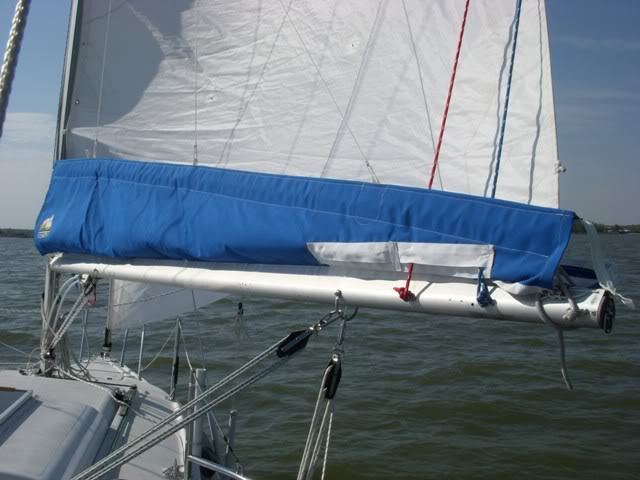
Now, there can be several problems with a stackpack. As you can see from the photo, it remains up while the sail is deployed. It can interfere with sail shape. You lose any benefit you might gain from having your mainsail loose-footed. But in addition, on my boat the stackpack itself acted as a sail. Combine all that with the broken zipper, and I removed it. I used the Stackpack lines to create a "lazyjack" system.

The photo above shows "lazy jacks" in position to catch the sail. Later I'll show how mine are positioned
while raising the sail and while sailing. I include the information now just for those who aren't yet
familiar with these sail management systems.
I mentioned the color of the broken zipper for a reason: that zipper was constantly exposed to UV rays, and for reasons I don't understand but can only report, white plastic is damaged more by UV rays than black. It seems counter-intuitive to me, since black absorbs all light while light reflects it, but maybe that only is true for the visible portion of the color spectrum.
I recently upgraded my topping lift because I had an extremely hard time using it. In fact, I couldn't use it. I should raise it while reefing, but I simply wasn't strong enough to pull it. So I dug through my collection of random hardware, and found this:

double block
and this:

double block with becket
Using these two pieces of hardware, I was able to change the purchase, or ability to pull, from a 2:1 ratio to a 4:1 ratio. It's still a bit of a tug; the topping lift raises the boom with the mainsail on it, and it's heavy, but it's much more manageable now.
Now, here's the point: I had my choice of blocks with white sheaves in them or black sheaves, and I chose the black ones. I also had a double block with becket the right size in my collection but with white sheaves, and when I looked at it, one edge of one of the sheaves was all chewed up and chipped. This is UV damage, and that rough, jagged edge would not have been kind to my topping lift line.
When you buy hardware for your boat, whether you buy it new or pick it up at a marine "yard sale," choose the ones with black plastic. they're far less likely to fracture when you need them most.
If you get something like a Stackpack that requires exposed zippers, instruct the canvas maker to use black zippers. When it comes to cockpit netting, it becomes a judgment call. Some boats look good with black netting, but mine isn't one of them, and black zippers on white netting wouldn't have been much better. However, zippers on netting are a lot easier to replace than a zipper on a Stackpack, and a lot more visible.
Right now I am laid up with what is probably a torn ACL I'm limiting how much I climb around the boat until the ACL can be dealt with, and that's keeping me from photographing things. I'll provide picture of both my improved topping lift and the damaged double block I found among my old hardware.
I'm going to say one more thing about all of this. Serious racers can be quite compulsive about keeping every possible ounce of weight down on their boats, and I get that. I understand they want to give themselves every possible edge.
But unless you're going to do intensive competitive racing on your boat, I vote in favor of keeping your lines a little long. Because my topping lift line was a little long, I was able to make this change without buying new line. I'm still going to dig through my stash of line, though, because the diameter of the line is unnecessarily small, making it harder to grip and harder to pull (just make sure your line isn't too big for the sheaves in your blocks, or you'll make the problem worse -- not better).
At 68, I have to expect that parts of my body are going to occasionally holler if they're overworked, and it's worth it to me to have more purchase and a larger line on my topping lift, but I also believe in being proactive. You can do these things even if you're young and fit -- you will still get plenty of exercise sailing your boat. Keep your running rigging easy to use. You may still have to give it all it's got if the ship hits the fan and you're trying to adjust things while the boat is heeled 20º.
https://www.facebook.com/boldlygosailing?skip_nax_wizard=true
https://www.facebook.com/boldlygosailing?skip_nax_wizard=true
Thursday, November 21, 2013
Really Bad Joke and a Small Amount of Information
So, a rope goes into a bar and sits down.
The bartender comes over and says, "You're a rope."
"Yes, I am," says the rope.
The bartender says, "We don't serve ropes in here. I'm sorry, but you'll have to leave."
So the rope gets up and goes outside. He ties himself up and fluffs out his ends. He goes back into the bar and sits down again on the same stool he was on before.
The bartender comes over to him and says suspiciously, "Say ... aren't you the rope I just threw out of here?"
Comes the answer: "I'm a frayed knot!"
Corny!!
A friend who has been sailing for over sixty years passed this tip on to us. He's amazed that he didn't learn it until he'd been sailing for more than 20 years.
When you coil a rope, do it clockwise, not counter-clockwise. The rope is twisted when it's made in a way that will cause it to want to knot all up if you coil it counter-clockwise.
He also had a tip about the "geezer halyard" I wrote about yesterday, in fact any halyard. He recommends against hanking the halyard and hanging it from its winch. You may need to use it very quickly. He recommends coiling it in a circle (clockwise, of course). He suggests stowing it in a bag. It will be much easier to use in a hurry if stowed that way.
Go to our Facebook page: https://www.facebook.com/boldlygosailing?skip_nax_wizard=true
The bartender comes over and says, "You're a rope."
"Yes, I am," says the rope.
The bartender says, "We don't serve ropes in here. I'm sorry, but you'll have to leave."
So the rope gets up and goes outside. He ties himself up and fluffs out his ends. He goes back into the bar and sits down again on the same stool he was on before.
The bartender comes over to him and says suspiciously, "Say ... aren't you the rope I just threw out of here?"
Comes the answer: "I'm a frayed knot!"
Corny!!
A friend who has been sailing for over sixty years passed this tip on to us. He's amazed that he didn't learn it until he'd been sailing for more than 20 years.
When you coil a rope, do it clockwise, not counter-clockwise. The rope is twisted when it's made in a way that will cause it to want to knot all up if you coil it counter-clockwise.
He also had a tip about the "geezer halyard" I wrote about yesterday, in fact any halyard. He recommends against hanking the halyard and hanging it from its winch. You may need to use it very quickly. He recommends coiling it in a circle (clockwise, of course). He suggests stowing it in a bag. It will be much easier to use in a hurry if stowed that way.
Go to our Facebook page: https://www.facebook.com/boldlygosailing?skip_nax_wizard=true
The Coolest Halyard on the Planet
The other day a club member proudly showed me a very clever modification he has made to his boat, and it's worth passing on. He calls it his "geezer halyard." This sailor is in his early 70's, not ready to give up sailing, but ready for some of the harder physical tasks to be a little easier.
Meanwhile I had heard from an old friend -- my long-lost first husband, actually, the man who introduced me to sailing and got me so hooked on it that I spent nearly 40 years daydreaming about returning to the sport some day. While he is generally in good health, he had to have rotater cuff surgery not that long ago, and was looking for easier ways to handle his boat. However, this adaptation isn't just for "senior citizens." I have a thirty-year-old daughter who has also had rotater cuff surgery. The truth is that any of us can have some sort of injury at any time that could make sailing harder for us.
If you look at the picture below, you'll actually see a couple of things this clever inventor has done to make his boat easier to manage. If you see the triangular thing sticking off the mast, that's one of a series of mast steps. With those mast steps, he can still climb his own mast.
Which he did. At the top, he used a pop rivet gun to attach a piece of hardware at the *very top* of the side of the mast. He attached an extra long halyard to that hardware. before leading that halyard through its sheave at the top of the mast, he first dropped it to near the bottom, and fed it through a block attached to a snapshackle. Then he took the halyard back to the top of the mast, through the sheave, back down the mast and through turn blocks to run it back to the cabin top and cockpit. (You don't have to run your halyards back to the cockpit, but it will make the boat much easier and safer to sail single-handed.)
In the picture below, the snapshackle for his halyard is run back to a loop on the top of his StackPack. If you're going to attach your halyard to a lifeline, that will require a little more length as well, so measure appropriately.
When he's ready to sail, he moves the snapshackle from his StackPack to the head of his sail. Because of the block attached to the snapshackle, he now has 2:1 purchase on his halyard. I tried it. His halyard is remarkably easy to raise. It certainly would make the task easier not only for those with shoulder injuries, but those with bad backs or arthritis in their hands.
This sailor put his block and snapshackle together from hardware he already had, but he's going to make a few changes.
First of all, the snapshackle he used is the type that swivels. This allows the two lengths of halyard going up to the sheave to twist, so it has introduced one more thing that can go wrong while raising the sail. Below are pictures of hardware I found at West Marine, a single block, and a non-swiveling snapshackle to attach to the becket.
It's still possible to get the two lengths of halyard twisted, but it's a good practice to eyeball the entire length of your halyard to look for things it might be hung up on anyway. The block costs about $36 at West Marine, and the snapshackle about $22. It's crucial that you use stainless steel hardware. You do not want your hardware to break at the top of the mast.
Besides the extra (but avoidable) chance of a fouled halyard, there are two other downsides to this adaptation. First, you'll have a lot of extra line in the cockpit after the sail is raised. Once your halyard is raised, you're going to have extra halyard in the cockpit. One option is to take a moment and hank the dangling halyard. If your halyard has a dedicated winch, you can put a loop over the winch, and the halyard will be stowed neatly. You can also find "line bags" on line you can hang near the bottom of your mast or in your cockpit to catch that line.
Second, you will have increased the number of turns your halyard has to make as you drop it. You may find that you have to go to the mast and help encourage the sail to drop when you're ready to take the sails down.
There's one more thing you might want to note about the hardware shown above: the sheave in the block I photographed is black. It seems counter-intuitive, but black plastic is more resistant to damage from UV rays than white. A block with a black sheave in it will last longer than one with a white sheave.
Finally, make sure your halyard size runs freely through the block, and that the snapshackle is large enough to attach easily to the head of your sail. If you choose a piece of hardware with a pin in it, make sure it's of a type where the pin can't be completely removed. The halyard hardware on my first boat used a pin that could fall out, and it did within five days. Then, of course, it bounced on the cabin top and into the marina. If a crucial piece of hardware can free itself it will, laughing all the way to the bottom.
Go to our Facebook page: https://www.facebook.com/boldlygosailing?skip_nax_wizard=true
Meanwhile I had heard from an old friend -- my long-lost first husband, actually, the man who introduced me to sailing and got me so hooked on it that I spent nearly 40 years daydreaming about returning to the sport some day. While he is generally in good health, he had to have rotater cuff surgery not that long ago, and was looking for easier ways to handle his boat. However, this adaptation isn't just for "senior citizens." I have a thirty-year-old daughter who has also had rotater cuff surgery. The truth is that any of us can have some sort of injury at any time that could make sailing harder for us.
If you look at the picture below, you'll actually see a couple of things this clever inventor has done to make his boat easier to manage. If you see the triangular thing sticking off the mast, that's one of a series of mast steps. With those mast steps, he can still climb his own mast.
Which he did. At the top, he used a pop rivet gun to attach a piece of hardware at the *very top* of the side of the mast. He attached an extra long halyard to that hardware. before leading that halyard through its sheave at the top of the mast, he first dropped it to near the bottom, and fed it through a block attached to a snapshackle. Then he took the halyard back to the top of the mast, through the sheave, back down the mast and through turn blocks to run it back to the cabin top and cockpit. (You don't have to run your halyards back to the cockpit, but it will make the boat much easier and safer to sail single-handed.)
In the picture below, the snapshackle for his halyard is run back to a loop on the top of his StackPack. If you're going to attach your halyard to a lifeline, that will require a little more length as well, so measure appropriately.
 |
The "Geezer Halyard." You can see the extended halyard dropping
from the top of the mast, through a block, and back up again.
|
When he's ready to sail, he moves the snapshackle from his StackPack to the head of his sail. Because of the block attached to the snapshackle, he now has 2:1 purchase on his halyard. I tried it. His halyard is remarkably easy to raise. It certainly would make the task easier not only for those with shoulder injuries, but those with bad backs or arthritis in their hands.
This sailor put his block and snapshackle together from hardware he already had, but he's going to make a few changes.
First of all, the snapshackle he used is the type that swivels. This allows the two lengths of halyard going up to the sheave to twist, so it has introduced one more thing that can go wrong while raising the sail. Below are pictures of hardware I found at West Marine, a single block, and a non-swiveling snapshackle to attach to the becket.
 |
| Hardware used to connect your 2:1 halyard to the head of your sail |
It's still possible to get the two lengths of halyard twisted, but it's a good practice to eyeball the entire length of your halyard to look for things it might be hung up on anyway. The block costs about $36 at West Marine, and the snapshackle about $22. It's crucial that you use stainless steel hardware. You do not want your hardware to break at the top of the mast.
Besides the extra (but avoidable) chance of a fouled halyard, there are two other downsides to this adaptation. First, you'll have a lot of extra line in the cockpit after the sail is raised. Once your halyard is raised, you're going to have extra halyard in the cockpit. One option is to take a moment and hank the dangling halyard. If your halyard has a dedicated winch, you can put a loop over the winch, and the halyard will be stowed neatly. You can also find "line bags" on line you can hang near the bottom of your mast or in your cockpit to catch that line.
Second, you will have increased the number of turns your halyard has to make as you drop it. You may find that you have to go to the mast and help encourage the sail to drop when you're ready to take the sails down.
There's one more thing you might want to note about the hardware shown above: the sheave in the block I photographed is black. It seems counter-intuitive, but black plastic is more resistant to damage from UV rays than white. A block with a black sheave in it will last longer than one with a white sheave.
Finally, make sure your halyard size runs freely through the block, and that the snapshackle is large enough to attach easily to the head of your sail. If you choose a piece of hardware with a pin in it, make sure it's of a type where the pin can't be completely removed. The halyard hardware on my first boat used a pin that could fall out, and it did within five days. Then, of course, it bounced on the cabin top and into the marina. If a crucial piece of hardware can free itself it will, laughing all the way to the bottom.
Go to our Facebook page: https://www.facebook.com/boldlygosailing?skip_nax_wizard=true
Monday, April 29, 2013
Why It Was Hard to Raise and Lower My Mainsail
Or, Bigger isn’t always better!
April 29, 2013
“Mine’s bigger!”
Some braggart
Ever
since I bought this boat more than two years ago, it’s been difficult to get
the mainsail up and down. Even using a winch, it took a lot of muscle power to
get the sail up. When it was time to come in, I had to go up to the mast and
tug the sail all the way down.
I
have “lazy jacks” on my boat. These are lines that pull out of the way to the
mast when not needed. However, when you want to lower the mainsail, you tighten
them by pulling on one small line on each side of the mast, and three lines
spread out on each side like a basket. They catch the dropping sail, which
should drop like a stone when released.
So
dropping the sail should be a piece of cake. It’s quite convenient when
single-handing, because you don’t have to try to both manage the boat and secure the
mainsail with ties immediately so it won’t flop around and block your vision all at the same time.
But
no matter what I did, the sail never dropped easily. It would drop a few feet,
and then stop. I would have to go up to the mast and manually pull the sail
down. That’s what you call inconvenient.
Someone
put lubricant on a paper towel and forced it to slide up the groove in the mast
where the slots that hold the sail to the mast travel. It didn’t help. I
sprayed the slots with silicon spray. It didn’t work. I tried other lubricants,
such as WD-40 and PB Blaster. Nothing worked.
Then
one day about six months ago, someone said, “Are you sure this is the right
sized halyard for the blocks in your mast?” Not being Superman, I lacked x-ray vision, couldn’t see
inside the mast, but as we looked at the line, it looked “fuzzy” –- it had been
rubbing on something. This wasn't degredation from UV rays; that part of the halyard had been protected in the mast.
So
I put a new halyard on the mainsail, one size smaller than the old line.
Immediately, the sail dropped like a stone any time I released it. That’s all
you have to do on my boat now when coming in –- tighten the lazy jack lines and
release the mainsail, and it drops like a stone, perfectly contained and under
control.
So
then I started thinking about my traveler. It was also hard to work, and its
lines were fuzzy also. So I looked at the blocks (unlike my situation with the
mast, they are all visible on the traveler), and sure enough, two of them were
quite small. The line was much too big for the smallest blocks it had to move
through, causing a lot of unnecessary friction. This is actually fairly
serious, because one very good strategy if you get hit with a sudden gust of
wind is to depower the mainsail by releasing the traveler.
I
had done all the same things to the traveler that I had tried with the mainsail
– lubricating everything with multiple lubricants, with minimal or no
improvement. Now I have smaller line on my traveler, and it works reliably and
with ease.
It
also turned out that the headsail sheets –- the sheets you use to tack your jib
or Genoa – were too big. I had self-tailing winches that couldn’t self-tail
because the line used was too big. I’d found that mistake early on because its
effects were so obvious, but it hadn’t occurred to me that the previous owner
might have oversized other lines as well.
It’s
easy to fall into the trap of thinking that “bigger is better” –- even safer –-
than smaller lines, but particularly when it came to the mainsail, the opposite
was true. Someone had to go stand on the cabin top and reach way up to pull the
sail down. Even holding on with one hand, that’s an inherently unbalanced
position. The cabin top of my boat has multiple levels and curves, and it’s
easy to take a misstep.
Your
mainsail halyard, especially if it moves through the inside of your mast, has
to make a number of turns. This is increased if your mainsail sheet comes back
to your cockpit, and you need that if you’re going to single-hand your boat. My
personal opinion is that all small and mid-sized sailboats should have running
rigging that allows you to single-hand. Maybe you never intend on doing that,
but if your sailing partner sprains an ankle, you’ll have a much easier time
getting back in if all your running rigging comes back to the cockpit. You’ll
also have your crew in a safer position than standing at the mast to raise and
lower the sail.
Since
this happened I’ve heard similar stories from a number of other sailors. So if
you find the lines on your boat seem to fight you, first trace them to make
sure they’re not caught on something (mainsail halyards, for instance, are
notorious for getting caught on things like the steaming light), and then
consider whether the line is actually the right size for the mechanical parts
it must travel through in order to do its job.
You
should always wear gloves when sailing. You’ll be able to grip the lines better
and pull harder, without worrying about a rope burn. But in addition, gloves
also make it easier to get a good grasp on smaller diameter lines. Bigger isn’t
better. The line that fits the hardware it will travel through is the size you
want.
Subscribe to:
Posts (Atom)