Showing posts with label pulling up the anchor. Show all posts

Saturday, February 8, 2014

Are You Really Gaining Experience ....

or are you just getting experienced at being lucky?

Most people who live along the Gulf of Mexico will remember an incident from several years ago. Four football players went out fishing on the Gulf of Mexico with tragic results. While the four men were missing but not yet found, one of the wives said, "I'm hopeful, because they're experienced boaters."

As it turned out, they weren't experienced in boating safely. They were experienced at being lucky, and on that day, their luck ran out.

At my sailing club, we were all surprised to hear they were 50 miles or so off shore -- at their favorite fishing spot -- because we had all known for days that a major front was coming through. It was March of 2009, and it's just a fact of life in Florida that fronts can come through and get the Gulf all riled up. Sailors and boaters should never ignore the weather, but especially January through March, when the fronts from the north can really make a mess out of the mostly shallow Gulf of Mexico.

But apparently these fellows were not aware of the fairly severe weather forecast. We noted at the club that not one person there had taken their boat out. In addition, the four fishermen were on a center console fishing boat. These boats are not designed for offshore use. They had been lucky in the past regarding the weather, and that luck had extended to using a boat inappropriate for the fishing they wanted to do.

Their luck ran out in March of 2009. They added to their problem by trying to retrieve an anchor that had set itself so hard that they couldn't get it back up. That can happen in rough water: the bow rises and falls, and with each rise and fall, the anchor sets itself more strongly. This can be a very good thing. You don't want your anchor dragging if you have to use it in a storm.

They compounded their problems by being determined to retrieve that anchor. When they couldn't get it up from the bow, they tied the end of the anchor rode to the stern of the boat, and then drove the boat forward. This can work ... when you're pulling a bush out of the ground with your car. (This is one more example of how driving a boat is completely different than driving a car). It can be a really bad idea in a boat. Boat vs. anchor, and the anchor won. It pulled the stern under (probably the waves helped), and the boat completely capsized.

If a sailboat capsizes, it is likely to right itself. The rigging may be destroyed, and you may have sailors injured and/or in the water, but they typically right themselves. This is not true of power boats.

So now they had four people in the water clinging to an upside down boat. One of the men dived under the boat and retrieved PFD's and water (they should have had their PFD's on already in rough water). Very sadly, three out of the four men drowned.

You may be doing something over and over that is a really bad idea, even though it has not made problems for you -- yet. One example might be running your engine harder than it should be run. My engine manufacturer tells me to never, ever run the engine above 3600 rpm. So I watch the RPM gauge, right?

Not exactly. I allow for a margin of error, because I'm not guaranteed that that RPM gauge is completely accurate. A friend just had his engine worked on, and one of the things the mechanic did was use a separate, digital tool to test how accurate his RPM gauge was. They discovered that his gauge was off by 400 RPM: when it read 3200, the engine was really running at 3600 -- redline for his engine also.

You might not be in the habit of routinely securing loose things below. Then a storm pops up unexpectedly, and you have damaged belongings in your cabin. Or, very commonly, you don't visit your boat often enough. I know of one person whose boat almost sank over a split hose, and another person who did have her boat sink over a split hose. These people aren't checking and working their seacocks, either, because they're not at their boats to do it. They're also not periodically starting their engines. Diesels love to run -- under load, not just idling -- and not doing this is not a good thing. I looked at a boat that was sailed often but not maintained well enough. The oil, when the engine was cold, was literally as thick as peanut butter. No way was I going to buy such a boat. The owners had gotten lucky and not had any serious engine issues because of their neglect of the oil. However, I wonder how the person who bought that boat fared. I know someone else who had a lot of water in her cabin. She didn't have time to sail, so she wasn't checking her boat. Her stuffing box was leaking, and the float valve on her bilge pump was sticking. Her boat also could have sunk. Her problem was spotted because she did the responsible thing and hired someone to do some basic maintenance.

You may be doing things as you sail that are not only inefficient but dangerous as well. Your best protection if you're a newer sailor is to actively network with other sailors. Don't be embarrassed to tell about the things that have gone wrong. Walk away from someone who sees this as a chance to look down their nose at you (they're out there), but cultivate the people who can show you what to learn from your experience. There is no more valuable friend a newer sailor can have.


https://www.facebook.com/boldlygosailing?skip_nax_wizard=true 


Friday, April 12, 2013

Getting Your Anchor Up -- Safely

Or, Do as I say and not as I did!

Most people who know me know I have figured out a number of strategies to compensate for not having the strength of a 25-year-old linebacker in his prime along with the coordination of a cat burglar. Too bad I don’t always use those strategies …

Today is a Friday. A week ago Wednesday I had to put down the hook in the Manatee River. When it came time to pull it up … I couldn’t muscle it up. So what did I do? Did I use the strategy I had not only figured out but methodically tested, guaranteed to treat an old body gently?

Of course not.

I tried to force it up. And then I tried harder to force it up. After all, I’m only 67, and everyone knows women are stronger than men …. Wait … what?????

I’m the person who has told so many people about the nifty system I came up with for using snatch blocks to free your anchor easily. But did I do it that day? No … I hadn’t actually set the system up permanently, and it seemed like “too much trouble” if I could just pull the thing up.

Now, I already knew that those three words – “Too much trouble” – can cause chaos. Many people don’t reef when they should because it’s “too much trouble.” I didn’t just hear about an efficient reefing system – I had it installed on my boat. I’ve used it. It works.

But I hadn’t actually installed my alternate system for raising the anchor. I would have to stop and find the parts, and then put them on. It was too much trouble when all I had to do was pull a little harder.

Dumb, dumb, dumb.

Well, I’ll tell you what’s too much trouble: having to go back to the doctor because the nuclear-strength anti-inflammatory drug she put you on made your feet swell up like watermelons, first sign of a rare but dangerous side effect of that drug.

Setting your phone to go off at 2:30 AM to take your Prednisone – and eat something so it won’t cause an ulcer – is a bit of bother.

And I brought it on myself because I really banged up my left shoulder trying to force that anchor out on muscle. I couldn’t “drive up on it” little by little because the wind had kicked up to about 20 mph. I’d move the boat forward, but by the time I’d gotten to the anchor rode, the wind had pushed the boat back, and the rode was tight again. That’s a game of tag you never win if you’re on the boat by yourself, which I usually am if I’m just moving the boat from home port to BCYC.

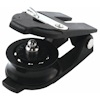
So what is my really good plan for freeing a strongly-set anchor? My boat has a perforated aluminum toe rail. That means I can put these nifty things called “snatch blocks” anywhere on the toe rail. 


These blocks open on the side so you can thread a line through them very easily. You don’t have to start at the bitter end and feed it all through. Since I have 250 ft. of rode, a snatch block definitely makes this task simpler than installing a standard block. You only need to pull out enough rode to be able to grasp it in the cockpit. You lock off the rode on the cleat by your sheet winch, and then loosen it at the bow. Now you can drive up on the anchor, pulling the rode into the cockpit as you go. You’ll have to take that rode back to the bow when you’re done, but you’re unlikely to tear up your shoulder doing that.

I use two snatch blocks to guide the rode back to the cockpit. Then I just put the boat into forward with no forward throttle, which inches the boat up, and pull the rode into the cockpit. If that’s moving the boat too fast, I simply “goose” the engine by moving it between neutral and forward, and then I have complete control of the forward speed. There’s no need to steer; an anchored boat will swing into the wind. If she swings off to the side, just give her a couple of moments to center up. Bringing in the anchor this way, there’s no chance the rode can get wrapped around the propeller.  Then I lock it off at the bow, and THEN I can drive the boat forward over the anchor, free it, and pull the chain and anchor up pretty easily.

Now, my forward cleats are on this very sturdy toe rail, so I don’t worry about ripping out a cleat. If your cleat is mounted to fiberglass, put a good backing plate on it – and don’t delay doing that because it’s “too much trouble.” Ripping a cleat out – now that’s too much trouble!

So why didn’t I put the snatch blocks on when I finally had to admit that my imitation of a gorilla in its prime had failed and I wouldn’t be pulling it up? Simple – the “gorilla” had already made spaghetti out of her shoulder. I was in a lot of pain and needed help raising that anchor. So I called Boat US. They put a tow line on the front of my boat. As they towed my boat forward, I easily pulled the rode in (no strain on the rode). When the chain was vertical, I locked it off on the cleat, and they pulled me forward again. It took three tries, but the anchor finally popped loose. I only had about 7 ft of chain and the anchor to pull up then, and I managed to do that.

The doctor hopes to clear me for full activity by May 1. That’s nearly four weeks of limited use of my left arm – and I’m left handed. The upside is that I’m getting to know the medical staff at my new doctor’s office pretty well.

LESSON LEARNED: Be smart. The applied uses of the simple machines – wheels (includes blocks), levers (ex: hammer), and inclined planes (ex: wood splitting wedge and screws), are tools our ancestors used to move us out of the stone age and into the industrial revolution. We should be smart enough to use them to help us do things like pull up anchors.

I probably dodged a bit of a bullet here. I have full range of motion in that shoulder, and they don’t think the rotator cuff is compromised, but I was foolish.

Don’t you be foolish. I have twice bought a set of snatch blocks by getting to marine flea markets early. They’re out there, and they’re useful. They’re also very inexpensive at flea markets – I recently paid only $20 apiece for them. My shoulder was worth $40! New, they start at around $160. I’m going to put them permanently on the toe rail, with badly applied seizing wire (on purpose) so it will take wire snips to remove them (and have a backup set in case one of these older wonders breaks or "takes a walk" to someone else's boat).

On your boat, you may have to install a couple of pad eyes (with backing plate) if you aren’t lucky enough to have a perforated toe rail (put backing plates on all your deck hardware), but none of this is hard. And, on my boat, it works. I’ve done it.  Wish I’d installed it, oh, about 11 days ago …

Sorry I don’t have a picture of the actual system up yet, but I have to let that shoulder heal some more first. I’ll do it in a week or so.