Saturday, February 8, 2014

Are You Really Gaining Experience ....

or are you just getting experienced at being lucky?

Most people who live along the Gulf of Mexico will remember an incident from several years ago. Four football players went out fishing on the Gulf of Mexico with tragic results. While the four men were missing but not yet found, one of the wives said, "I'm hopeful, because they're experienced boaters."

As it turned out, they weren't experienced in boating safely. They were experienced at being lucky, and on that day, their luck ran out.

At my sailing club, we were all surprised to hear they were 50 miles or so off shore -- at their favorite fishing spot -- because we had all known for days that a major front was coming through. It was March of 2009, and it's just a fact of life in Florida that fronts can come through and get the Gulf all riled up. Sailors and boaters should never ignore the weather, but especially January through March, when the fronts from the north can really make a mess out of the mostly shallow Gulf of Mexico.

But apparently these fellows were not aware of the fairly severe weather forecast. We noted at the club that not one person there had taken their boat out. In addition, the four fishermen were on a center console fishing boat. These boats are not designed for offshore use. They had been lucky in the past regarding the weather, and that luck had extended to using a boat inappropriate for the fishing they wanted to do.

Their luck ran out in March of 2009. They added to their problem by trying to retrieve an anchor that had set itself so hard that they couldn't get it back up. That can happen in rough water: the bow rises and falls, and with each rise and fall, the anchor sets itself more strongly. This can be a very good thing. You don't want your anchor dragging if you have to use it in a storm.

They compounded their problems by being determined to retrieve that anchor. When they couldn't get it up from the bow, they tied the end of the anchor rode to the stern of the boat, and then drove the boat forward. This can work ... when you're pulling a bush out of the ground with your car. (This is one more example of how driving a boat is completely different than driving a car). It can be a really bad idea in a boat. Boat vs. anchor, and the anchor won. It pulled the stern under (probably the waves helped), and the boat completely capsized.

If a sailboat capsizes, it is likely to right itself. The rigging may be destroyed, and you may have sailors injured and/or in the water, but they typically right themselves. This is not true of power boats.

So now they had four people in the water clinging to an upside down boat. One of the men dived under the boat and retrieved PFD's and water (they should have had their PFD's on already in rough water). Very sadly, three out of the four men drowned.

You may be doing something over and over that is a really bad idea, even though it has not made problems for you -- yet. One example might be running your engine harder than it should be run. My engine manufacturer tells me to never, ever run the engine above 3600 rpm. So I watch the RPM gauge, right?

Not exactly. I allow for a margin of error, because I'm not guaranteed that that RPM gauge is completely accurate. A friend just had his engine worked on, and one of the things the mechanic did was use a separate, digital tool to test how accurate his RPM gauge was. They discovered that his gauge was off by 400 RPM: when it read 3200, the engine was really running at 3600 -- redline for his engine also.

You might not be in the habit of routinely securing loose things below. Then a storm pops up unexpectedly, and you have damaged belongings in your cabin. Or, very commonly, you don't visit your boat often enough. I know of one person whose boat almost sank over a split hose, and another person who did have her boat sink over a split hose. These people aren't checking and working their seacocks, either, because they're not at their boats to do it. They're also not periodically starting their engines. Diesels love to run -- under load, not just idling -- and not doing this is not a good thing. I looked at a boat that was sailed often but not maintained well enough. The oil, when the engine was cold, was literally as thick as peanut butter. No way was I going to buy such a boat. The owners had gotten lucky and not had any serious engine issues because of their neglect of the oil. However, I wonder how the person who bought that boat fared. I know someone else who had a lot of water in her cabin. She didn't have time to sail, so she wasn't checking her boat. Her stuffing box was leaking, and the float valve on her bilge pump was sticking. Her boat also could have sunk. Her problem was spotted because she did the responsible thing and hired someone to do some basic maintenance.

You may be doing things as you sail that are not only inefficient but dangerous as well. Your best protection if you're a newer sailor is to actively network with other sailors. Don't be embarrassed to tell about the things that have gone wrong. Walk away from someone who sees this as a chance to look down their nose at you (they're out there), but cultivate the people who can show you what to learn from your experience. There is no more valuable friend a newer sailor can have.


https://www.facebook.com/boldlygosailing?skip_nax_wizard=true 


Tuesday, February 4, 2014

This Is not a Happy Topic

... Skin Cancer


It is widely believed among those who get a lot of sun exposure that having a tan will protect one from skin cancer. It *will* protect you from a casual burn, but it will not protect you from skin cancer. 

As I have recently found out, bad burns during child put one at greatly increased risk for squamous-cell skin cancer. 

You may have heard that the only "serious" skin cancer is melanoma. Melanoma is nothing to laugh at, that's for sure, but under the wrong circumstances, squamus-cell and even basal cell can become serious. As it happens, I haven't had yearly skin examinations, but I am saying now: GET THAT YEARLY SKIN EXAMINATION.

It wouldn't have helped me, as it turns out, unless that examination had been within the last three months or so, but most of the time it helps a great deal. I happen to have a rapidly growing squamous-cell skin cancer, on the bridge of my nose, and it's going to have to be dealt with aggressively. Most of the time, though, if you get that yearly skin examination, the doctor will find any skin cancers (even melanoma, which is highly treatable now if caught early) in plenty of time.

I have noticed that when I offer sunscreen to people on my boat, women take it if they forgot to use it, but men? I can't think of a single man I have ever seen use sunscreen. No, that's not true. I do know a couple. They have both had skin cancer and I guess the doctor got their attention.

Just because a skin cancer can USUALLY be removed in plenty of time does not mean you should be casual about this. Wear hats, and use sun screen. Unfortunately it hadn't been invented when I was a child, so a lot of people of my age are going to have otherwise unnecessary skin cancers. 

Don't be foolish. Use good sun screen, and reapply it periodically. Wear a hat (if it storms, you have my blessing to take it off in favor of your foulie hood!)

And get that yearly skin exam. Then, just because the doctor says "it's no big deal," don't think that means you're chasing monsters under the bed. It's just that you caught the monster very early. That's a very good thing to do.


https://www.facebook.com/boldlygosailing?skip_nax_wizard=true
Wednesday, January 29, 2014

Memory Foam


Or, Gee, that bunk is hard!


You don’t have to live on your boat to need a comfy place to sleep. At the end of a day full of sailing, you’ve done a lot of physical work, and while you probably could sleep on a bed of nails, it should not have to be your only choice.


Enter memory foam. I don’t think that name is trademarked as I have seen it on foam toppers in stores like BIG LOTS and WAL-MART.


I’m not talking about the foam pads, often waffled in texture, from days gone by. I’ve tried those for other purposes. Maybe they make a psychological difference, but by morning your body will know there was nothing of significance on top of that lumpy, or old, or hard, mattress.


Memory foam is different in that it actually improves comfort. Yes. I’m saying it’s worth the money. And it’s not that much money any more. A twin bed-sized memory foam topper, 4” thick, may not cost you more than $100. Put it on top of the hard cushions typically used on most sailboat bunks and you’ll be a happy camper. My vee berth would require a double-bed size, but that doesn’t cost much more. 


Mention of the vee berth in particular brings us to the issue of shape. Very few things come to a right angle on sailboats, and only rarely is something like a berth standard-sized. That means you’re going to have to cut this foam, and cutting 4” foam can be a challenge. (I do recommend getting the 4”, but I like a soft bed.)


Unless you have an electric knife. Happily, I found one at WAL-MART in their small kitchen appliance center for only ten dollars . I didn’t even bother to try to make a pattern. I simply put the foam on the berth, and cut away the extra foam. I recommend doing that in several stages so you don’t accidentally cut away too much. You may find that your berth is, say, 2” shorter than the foam. Don’t try to force the knife through the foam too fast, and try to keep the knife vertical. However, the foam is packaged quite tightly at the factory, and you may find that it won’t really be completely its final shape until about 24 hours after you have unpacked it.


If you shape the foam precisely, it will fit snugly and tend to stay in place. I had to cut the front edge at an angle, as the berth was the width of a twin bed at one end but not the other. In addition, notches had to be cut out of the back edge. But any mess from the foam is easy to clean up afterwards.


These foam toppers come with mattress covers, which quite naturally are rectangular. Getting the cover on your cut foam is a battle and I suggest you have someone to help you with it.


Then flip the mattress over, and get a needle and thread. Pull the mattress cover tight, working from the edges to the middle, and just baste the folds of extra fabric down, and the mattress cover won’t shift around on you. It doesn’t have to look pretty; no one will ever see it. I also suggest putting a second mattress cover over that. That one will go on much easier than the first one did, and be more easily removable for laundering.


If you really want to go all-out, you can also modify a set of twin or double sheets (or whatever size you’re working with) to fit, but since that’s going to show, if you don’t have good sewing skills, find someone who does have the skills to do that. This time you will have to work on the top side, but a good seamstress can take the extra fabric up where the sheet folds over the edge of the foam, and you won’t have to lie on – or look at – a seam going down the middle of your mattress.


I don’t recommend using memory foam instead of the cushions already on your berth. Those cushions are made for a marine environment and meant to hold up to things like people sitting on them. But you can stow them in the vee berth during the day and pull them out at night if you live on your boat, or store them in any place free of dampness if you only use your boat on occasional weekends.


I have found this moderately priced memory foam to be extremely comfortable, and I’m a “Princess and the Pea” kind of woman – if the bed isn’t comfy, it drives me nuts.


Good luck with this, and … sweet dreams!


https://www.facebook.com/boldlygosailing?skip_nax_wizard=true

Monday, January 27, 2014

Choosing Hardware

Or, As plain as black and white


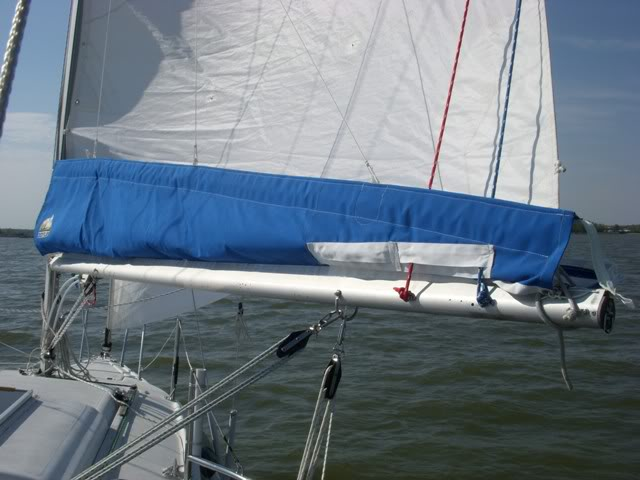
When I bought this boat, she had a "StackPack" for the mainsail. A Stackpack is a Sunbrella™pocket attached to the boom. It catches the mainsail when you drop it, and then zippers closed. The Stackpack looked as if it were fairly new, but the white zipper was broken, and the top of the sail was exposed to the sun's UV rays. The top was also so high up that I really couldn't reach the zipper.


Now, there can be several problems with a stackpack. As you can see from the photo, it remains up while the sail is deployed. It can interfere with sail shape. You lose any benefit you might gain from having your mainsail loose-footed. But in addition, on my boat the stackpack itself acted as a sail. Combine all that with the broken zipper, and I removed it. I used the Stackpack lines to create a "lazyjack" system.


The photo above shows "lazy jacks" in position to catch the sail. Later I'll show how mine are positioned
while raising the sail and while sailing. I include the information now just for those who aren't yet
familiar with these sail management systems.

I mentioned the color of the broken zipper for a reason: that zipper was constantly exposed to UV rays, and for reasons I don't understand but can only report, white plastic is damaged more by UV rays than black. It seems counter-intuitive to me, since black absorbs all light while light reflects it, but maybe that only is true for the visible portion of the color spectrum. 

I recently upgraded my topping lift because I had an extremely hard time using it. In fact, I couldn't use it. I should raise it while reefing, but I simply wasn't strong enough to pull it. So I dug through my collection of random hardware, and found this:
double block

and this:

double block with becket

Using these two pieces of hardware, I was able to change the purchase, or ability to pull, from a 2:1 ratio to a 4:1 ratio. It's still a bit of a tug; the topping lift raises the boom with the mainsail on it, and it's heavy, but it's much more manageable now.

Now, here's the point: I had my choice of blocks with white sheaves in them or black sheaves, and I chose the black ones. I also had a double block with becket the right size in my collection but with white sheaves, and when I looked at it, one edge of one of the sheaves was all chewed up and chipped. This is UV damage, and that rough, jagged edge would not have been kind to my topping lift line.

When you buy hardware for your boat, whether you buy it new or pick it up at a marine "yard sale," choose the ones with black plastic. they're far less likely to fracture when you need them most. 

If you get something like a Stackpack that requires exposed zippers, instruct the canvas maker to use black zippers. When it comes to cockpit netting, it becomes a judgment call. Some boats look good with black netting, but mine isn't one of them, and black zippers on white netting wouldn't have been much better. However, zippers on netting are a lot easier to replace than a zipper on a Stackpack, and a lot more visible. 

Right now I am laid up with what is probably a torn ACL I'm limiting how much I climb around the boat until the ACL can be dealt with, and that's keeping me from photographing things. I'll provide picture of both my improved topping lift and the damaged double block I found among my old hardware. 

I'm going to say one more thing about all of this. Serious racers can be quite compulsive about keeping every possible ounce of weight down on their boats, and I get that. I understand they want to give themselves every possible edge.

But unless you're going to do intensive competitive racing on your boat, I vote in favor of keeping your lines a little long. Because my topping lift line was a little long, I was able to make this change without buying new line. I'm still going to dig through my stash of line, though, because the diameter of the line is unnecessarily small, making it harder to grip and harder to pull (just make sure your line isn't too big for the sheaves in your blocks, or you'll make the problem worse -- not better).

At 68, I have to expect that parts of my body are going to occasionally holler if they're overworked, and it's worth it to me to have more purchase and a larger line on my topping lift, but I also believe in being proactive. You can do these things even if you're young and fit -- you will still get plenty of exercise sailing your boat. Keep your running rigging easy to use. You may still have to give it all it's got if the ship hits the fan and you're trying to adjust things while the boat is heeled 20º.


https://www.facebook.com/boldlygosailing?skip_nax_wizard=true 

Sunday, January 26, 2014

You COULD Go Over the Side -- Really! -- Lifelines

No smart cracks this time -- this is serious stuff

I have heard about lifelines from a couple of people ever since I got my first little sailboat. People are passionate in their beliefs about them.

For instance, there's a big debate about whether they should be clad in vinyl or not. Many owners feel the vinyl looks nicer, even though vinyl-clad cable is more expensive than bare cable. Others insist that it's extremely important to have bare cable, because vinyl can hide the first signs of rust, a sign that your lifelines could fail.

Oh my gracious -- then you could fall overboard, right?

Well, yeah, you CAN fall overboard, but it can happen if you have the newest, brighest, tightest lifelines possible.

How is that possible?

Just go stand on the side of your boat, and note where the lifeline touches your body. Unless you're a child, it's going to be WELL below your waist. This means that your center of gravity is WELL above that top lifeline (assuming you have two -- smaller boats will only have one). 

The lifelines can't save you, I don't care what the "experts" say. I know a true expert who calls loose or weakened lifelines "deathlines." He's been sailing for many, many years and figured out long ago that the lifelines won't save him, but it's hard to ignore that word -- LIFEline.

Well, you have to. Words don't trump the laws of physics.

So what are they good for? They're an OUTSTANDING visual guide. They make it very, very clear where the edge of the cliff is. But once you have realized that those lifelines won't save you (and could actually encourage you to topple over), you'll realize why you want to move toward the bow from the HIGH side of the boat. On the high side of the boat, if you do fall, you'll fall toward the center of the boat -- not into the water.

What else can you do? My boat is 100% netted. I even made a frame with netting on it that lashes to my gates when they're closed. I have a coordination problem (talked about in a much earlier post), so I'm more likely than you to go over the side. Not everyone wants netting but I think it's wise for me.

The other thing you *must* do is make sure you have good handholds along the edge of your cabin top. You often see these made of teak. My boat also has a stainless steel grab bar that runs across the beam. We hear the saying, "One hand for yourself and one for your boat," and that's exactly what it means. As you move forward, you should always be holding on with one hand, and you shouldn't be holding the lifeline. You should be holding something closer to the center of the boat.

If the boat is sailing and you need to do something at the mast, move to the mast from the high side of the boat, where gravity will tend to push you toward the boat, not away from it.

Wear nonskid shoes. I don't care how many macho men tell you bare feet are best: if you break a toe, you're going to be significantly hobbled. Test their grip on your deck periodically, as the grip-holding tendencies of your shoes can wear out.

Don't count on the "life" lines to save you. Do keep them in good shape, but they are last-ditch, and in my opinion, best used by attaching netting to them.


https://www.facebook.com/boldlygosailing?skip_nax_wizard=true

Saturday, January 25, 2014

Dirty Fuel

or, Good heavens -- you have to clean EVERYTHING!

I have had this experience with both outboard and diesel engines. I've never had a gas inboard (ex: Atomic 4), so I can't speak to that.

You wouldn't think anything could grow, thrive and even make huge problems in something that seems as noxious to us as diesel fuel, but unfortunately (as the fellow said in JURASSIC PARK) -- life seems to find a way.

There are critters, most typically a type of algae, who think your tank of diesel is heaven on Earth. Unfortunately like all life forms, they reproduce. Unfortunately like all life forms, they also die.

Once they've died, they settle to the bottom or stick to the sides of your tank, where they may make no problems for years. They may not show up as dirt in either of your fuel filters. They may, however, gather in your fuel line.

You may have no awareness of this until something disturbs either your fuel lines or your fuel tank. 

I have often said that my experience is not as extensive as many, but I have sailed intensively since I started, and I have had several experiences with dirty diesel fuel. Fortunately for me, the first time it happened, I was on someone else's boat. He had been in a three-day race in early January. Now, sailing off Florida in January can be pretty dicey, because when fronts come through from the North, they often pack a punch. On the East coast, the northern wind pushes against the Gulf Stream, which flows roughly from south to north at a pretty good clip. When the two collide, very large waves (especially for newer sailors like us) can be the result. You want to check the weather carefully before crossing the Gulf Stream any time, but in winter it is often a problem.

On the west coast where I live, we have a different set of problems. We get the same north winds, this time blowing over lots of open, relatively shallow water. A minor front can create 8' waves in the Gulf of Mexico near the shore, with even larger waves further off shore. 

But none of this mattered to my friend, who is a master sailor and ardent racer. Nothing stops him, and with his experience he has a solution for everything. One race unfortunately coincided with a stalled front, and winds were high and the waters rough throughout the race. When one of his crew members got so seasick she was dizzy and disoriented, making bad judgment calls and a danger to herself, the rest of the crew simply tied her to the mast so there was no risk of her going overboard. 

His boat performed well in the race, but then he had to move his boat from Clearwater back to Gulfport. It was still too rough to go outside without a full crew, so I went up to Clearwater just to keep him company as he brought the boat down via the more sheltered Intracoastal Waterway. This man loves to teach and pointed out a lot of valuable information to me.

Then came the unintended lessons: right as we were about to go under a bridge, his diesel engine died. He steered the boat through the bridge, glided over to the side of the waterway, and put an anchor down. The problem was immediately obvious: both his Racor filter and his engine filter (often called the "secondary" filter) were black with dirt. He put a plastic red Solo-type cup under the Racor and drained the fuel. He passed the cup to me, and I set it on the nearby galley counter. He changed that filter and the engine filter, and we were shortly on our way. About a half an hour later he pulled the boat over again, put the hook down, and checked the filters, which were clogging up again. He has some clear tubing in his fuel system. He looked at the fuel going to the engine, and it seemed clean, so he started her up again. Eventually she sputtered, but we made it back to Gulfport with just one more round of filter changes.

Unfortunately, it's a very bad idea to drain fuel into a Solo cup. Diesel dissolves that kind of plastic, and we had a mess to clean up in the galley. Keep a glass jar (maybe the size spaghetti sauce comes in) with your engine tools, wrapped against breakage, in case you have to drain your Racor filter.

So then the question was "why?" My friend believes that the rough three days of racing sloshed the fuel around with vigor, essentially scrubbing a lot of dirt collected over years of use back into the fuel. Diesel engines are very sensitive to supply interruption. A tiny air bubble can bring it to a stop, which is why your manual explains how to "bleed" the engine of air bubbles. A tiny bit of water can stop it, which is why you should have a Racor-type filter, which catches water as well as dirt. Dirt in the fuel can stop it. This is all because of the way diesel engines work: very small jets spray a very fine mist of fuel through injectors. Because that spray is so fine, the smallest (noncombustible) thing can replace the diesel, depriving the engine of fuel. Gas engines aren't as sensitive to these things as diesels are. My friend got rid of his fuel and cleaned his tanks, and solved the problem, at last for then.

Eventually my friend needed a new engine, and then he suddenly had fuel interruption problems again. He had his tank cleaned, and got rid of the old fuel (if your boat holds a lot of fuel, there are companies that will "polish" it for you and clean it up) -- but the problem persisted. What my friend eventually discovered was that his fuel lines were so clogged with dirt that it didn't matter how clean his fuel and tank were. He replaced those hoses and had no more problems.

Later on, I also had the same problem, again stemming from sailing in rough water, but in spite of my previous experience with my friend, I didn't realize what the problem was at first. All I knew was that the engine would unexpectedly die. The first time it happened, someone suggested that my propeller had caught a piece of line floating in the water and then released it. He said, "Sometimes that happens." When it happened two more times, however, I discounted that theory. I didn't picture a stray rope catching on my propeller *and* spontaneously freeing itself three times. Each time I bled the engine, and each time the engine started up. I was thinking I had a little air leak in the fuel system somewhere, but I took a "wait and see" attitude. Then one evening while taking the boat out for a moonlight sail on the Gulf with friends, she died completely, and bleeding didn't get her going again. Now, on this engine, parts had to be taken off the engine to get at that filter, and the Racor was in an inaccessible place (if your boat is like that -- move it!) I thought I was out of fuel. With no fuel gauge, it can be hard to know when getting fuel is crucial.

At the fuel dock, the boat took only five gallons. That's when it dawned on me -- dirty fuel. 

Several days later, a friend climbed down into the very deep lazarette at the back of the boat, we pumped out all the dirty fuel, and he cut a hole in the tank. We started passing him pieces of oil pad. My oil pads are about 24" square, and we cut one into fourths. We passed a piece down to him, and he passed it back up soaked up at least 2 lb. of sludge -- and he had barely begun. What a mess, but it had to be done.

This is a big pile of oil pads, sometimes called "engine diapers," but that is also the correct name for
something else, so at the store I suggest you ask for oil pads. You lay one under your engine to catch
oily drips so they don't go into the bilge. Unless you have a big clean-up, if your engine is running properly,
you should just put one under your engine, check it periodically, and replace as necessary. One may
well last a year or more. The material they are made of absorbs petroleum products but not water,
making them very good for cleaning up small petroleum spills. You can buy them in smaller quantities
and for most people, having three or four on hand is plenty.

I was lucky, and my fuel hoses were OK. We had a fabrication shop make a cover for the hole in the fuel tank, with a diesel-resistant gasket (I had them make me a second one to have on hand just in case something happens to the one I have, since it was custom). Surprisingly, that fabrication was inexpensive.

It was a real hassle to do all of that, but I don't worry about getting caught in rough water now. Think about it -- as I've said before, when the ship hits the fan, turning the engine on and being ready to use it can be a good strategy, especially for newer sailors. You need to be sure your tank isn't all clogged up with gunk.

However, I urge you to check with your engine manufacturer and find out which algae-controlling additive they recommend -- and then use that specific brand (and do use it)! I say to check with the manufacturer because part of my problem was that I just picked something off West Marine's shelf. I knew no anti-algae agent had been in the fuel, so I followed the  instructions on the bottle to "shock" the tank by using a larger dose than usual. As it turns out, that can be a very bad idea, because if you have lots of live algae in the tank, they will all die at once, and sink to the bottom, which is where your fuel line picks up its fuel. My problem started when I shocked the fuel with this stuff. When my friend cleaned the tank, he found extra heaps of sludge around the fuel pickup. We had to pass him other tools to clean that area out well.

My Yanmar manual actually states not to use the product I used (sorry but I don't remember the name), so I went to the Yanmar dealer. They showed me exactly what to use and made sure I knew how to use it.

Check both your Racor (a valuable and relatively inexpensive engine protection) and your "secondary" filter (the one built into the engine) periodically as part of sensible routine engine maintenance.


https://www.facebook.com/boldlygosailing?skip_nax_wizard=true

Wednesday, January 8, 2014

Sailing in Gusty Winds -- a great link!

People who have sailed for many years mostly know this information, but this blog is for people with less experience, and one of the more challenging situations for newer sailors is when the weather turns gusty. You could be unexpectedly caught in gusty weather for a number of reasons. You might have expected to get back in long before the bad weather hit, but something goes wrong and you don't make it.

You need to know how to handle gusty weather. Not only will you and your companions be uncomfortable otherwise -- someone could be hurt. They could be moving toward the head when a gust hits and fall in the cabin (fall in the cabin and you're very likely to have a bad fall), or sprain something when thrown off balance, or be hurt while moving forward to deal with something.

The webpage listed below covers what to do extremely well. I'll just make a few comments in case the information doesn't quite make sense. Here's the website:

http://learntosail.hubpages.com/hub/Three-Sailing-Tips-for-Less-Heel-in-Gusty-Breezes

And here's the core, with my comments in blue:

"1. Luff up on a Gust
Watch the water to windward. Look for dark, ruffled spots that signal the arrival of a gust. Point up toward the wind just before the gust arrives. This will luff the forward part of your sails and depower them--but keep the boat driving and on her feet!"

 Start learning to read the surface of the water now. The surface does change as the wind changes. On a light wind day, you can see puffs of stronger wind coming to take advantage of them. On rough days, you can see them coming and strategize.

So what does "luff up" mean? It means to make the sales "luff," or shake. It typically (but not always) starts at the luff, or leading edge, of the sail. You make the sail luff by steering more directly into the wind. A sailboat pointing into the wind can't sail because it can't catch any wind, and it can't use the sails as an air foil. The boat is depowered, which is what you need in too much wind. You need to depower the sails. This is one way to do it, and if the gusts are significant, you need to be in position before the gust hits.

You can also steer into the wind as you feel the wind rising. Gusts often occur on a curve -- the first increase will not be the peak, and you still have time to ease its impact on your boat, but also learn to read the waves.

What does "still driving the boat" mean? The writer is suggesting that you don't point the boat completely into the wind -- just enough to weaken the effects of wind on your sail. You're still moving, and the boat is "on her feet" -- not heeling excessively.

So what this is really about is steering. Now, steering is easier when the boat is in balance, which is covered a little further below.

"2. Ease your Sheets / Back your Blocks
Move the mainsheet car down the traveler track to leeward. Ease the mainsheet a few inches. Then, set your headsail sheet blocks back a few holes along the Genoa tracks. These actions cause the top of your sail to open--or twist--to spill high octane wind up high. This keeps heel down for a more balanced boat."

What's the "mainsheet car?" I could show you a picture of mine, but yours might look different. The "traveler track" moves across the beam of the boat. Sometimes it's across the cabin top, as mine is. Sometimes it's in the floor of the cockpit, right in front of the companionway. Sometimes it's at the back of the boat. Some smaller boats don't have travelers -- my little 25' Irwin didn't have one.

If you have a traveler, you release both traveler lines, and then pull on the leeward line. If the wind is coming over your port side, you pull on the starboard traveler line, and move the sail controls to starboard. This causes "twist" at the top of the sail. You can spot this because the curve of the leech -- the back edge of the sail -- will now have a more exaggerated curve in it, especially toward the top. This makes the sail more inefficient. It's an easy and quick way to depower your mainsail. If the gust was significant enough to make your boat heel too much, she should immediately settle down and heel less, what the author means by "keeping heel down."

But what does a "more balanced boat" mean? Without getting technical, the more balanced the boat is, the less physical exertion it takes to steer the boat. But it *also* means that the boat is more in control. Using the traveler to move the sail to leeward is a quick and effective method to "spill the mainsail" so it can't hold as much wind. You have effectively, temporarily turned your mainsail into a smaller sail.

OK, so what does "back your blocks" mean? The sheets for your headsail come back to the cockpit after being led through a moveable block that sits on a long track. The position of that block can dramatically affect the shape of your headsail. When the winds pick up, adjusting your mainsail as described above may not be enough to get your boat back in balance and sailing easily (which you judge easily by the amount of effort needed to steer her). If you move those blocks back toward the stern, you ... twist the headsail as well, causing wind to spill out of the top, and in effect, making your headsail smaller. 

Now, this isn't as easily (or as safely) done as adjusting the traveler. To move the blocks you have to first notice where the load is. Which is the working sheet? Well, in the scenario above, the wind was coming across the port side of the boat (a "port tack"). This makes the STARBOARD sheet carry the load. The port sheet is slack. So that's the one to adjust first, even though it won't change the sail. Slide it back as much as you think you need. Now, if you've gone out and practiced, you'll be able to make an educated guess. If you haven't practiced that yet, then your rule of thumb might be -- the stronger the gusts are, the more you should move it back.

Now you have to move the loaded block, and that can be more dangerous. You have two choices.

First choice is to switch to a starboard tack. The problem with that choice is that tacking isn't a lot of fun in rough water and winds that are overpowering your boat. It's not impossible, but make sure there's no one in the cabin and that everyone is secure (they do have PFD's on, right?) After the tack, your starboard sheet will be the "lazy" sheet and you can move the block toward the stern easily.

If tacking seems like a bad idea (whoever works the sheet is going to have to pull hard and fast on the new working line, and the helmsman should watch his or her progress, and not complete the turn until the new working sheet is under control and tight enough), here is how to move the block while the sheet is under load:

Always remember: ONE HAND FOR YOU AND ONE FOR THE BOAT. Don't use both hands doing this in rough water. 

Step firmly on the working jib sheet FORWARD of the block. Keep the tension on that sheet with your foot, hold on to something firm (not just a life line, but a stanchion or cabintop handhold, or bimini frame if it's very secure), and slide the block back. If you have to do this more than once to make sure you are holding on to the boat, so be it. You can do this twice. 

If you have two people on the boat, that second person should be on the helm. You'll be standing on the high side of the boat, and that will make it easier for you to do this.
 
"3. Reef your Sails
Combine the first two actions with sail reefing. One of the great misconceptions in sailing is that reefing is a heavy weather tactic. Nope--it's a balancing tactic. Reef earlier than you think necessary. Reduce or change out the headsail. Tuck a reef or two in to the mainsail. Reefing keeps the boat on her feet and the helm light as a feather."

 If you're going to change your headsail, please be aware of the weather before you are in it, and change the sail before it's actually needed. Changing a headsail can be extremely dangerous in high winds and/or rough water. When a boat is out of balance, the bow bounces around and moves unpredictably. If you slip up and the sail goes into the water, do you know what you have to do? You have to whip out your knife, cut the sail free and let it go, because a sail in the water at the bow can sink a boat. 

So do it while the winds are low.

Another option is to partially furl your roller furler, but understand that if you do that more than a couple of times it will permanently deform your headsail. This is not something covered by insurance, even though it's weather related. The result is that your headsail will always perform more inefficiently, and your boat will slow down some. Well, that's life -- safety first, but if you pay attention to the weather, you may avoid having to use your headsail in this way.

There's a hidden, important message in all of this: how the helm feels may be your best sign of whether it's time to twist the sails, and if that doesn't do the job, to start reefing.

What this all means is that you mustn't be shy about taking your boat out, little by little, in stronger winds than you're used to. If you're used to 10 mph winds, take her out in 15. Sail her on all points of sail. Make judgments about whether your boat needs to be reefed at this point. Some smaller boats probably should be reefed at 15 mph. 

Then take her out at 18 mph, and then 20, etc. Most people are not this methodical (and it's not typical for me, but I realized that sailing was a little more risky for me than some other people, and I just made myself do it. I am now convinced it's a good idea for all newer sailors.)

Three simple tips in that article -- simple for experienced sailors, that is. As you take your boat out for recreational cruises, pick one new skill to practice each time. Then when the ship hits the fan, you'll already know how to execute the excellent tips in that article. 


https://www.facebook.com/boldlygosailing?skip_nax_wizard=true